
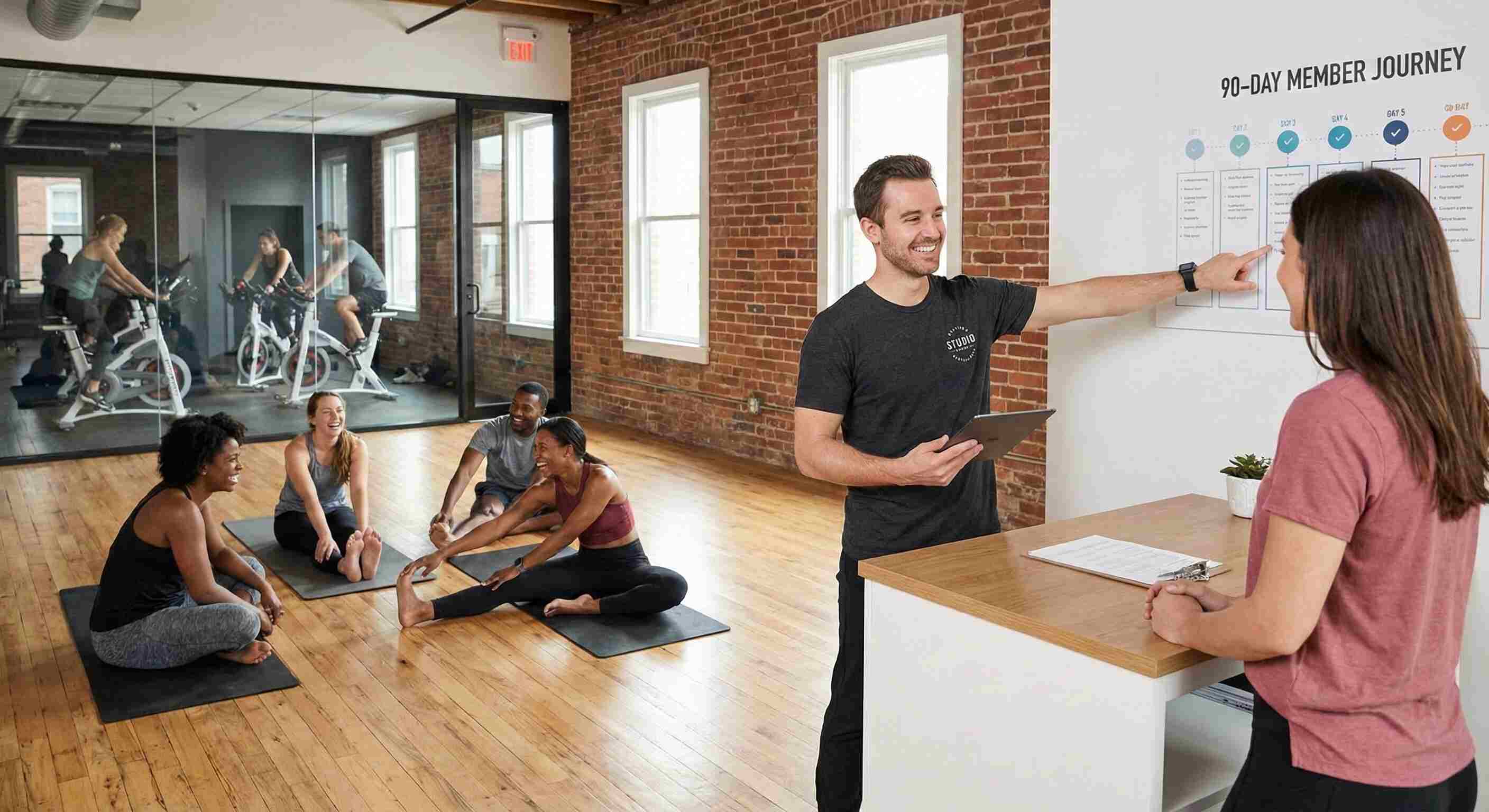
Fitness studio pre-launch marketing requires a 90-day runway divided into three phases: foundation building (lead capture systems and messaging), local visibility (community partnerships and pop-up events), and conversion (soft launches and countdown campaigns). Studio owners who follow this structured approach open to engaged members rather than empty rooms because they have already built an email list, established local recognition, and converted warm leads before their doors officially open.
What This Guide Covers: Pre-launch marketing for boutique fitness studios (yoga, pilates, cycling, barre, HIIT, or similar specialty formats) during the 60 to 90 days before opening. This differs from ongoing marketing because the studio has no existing members, no operational track record, and no physical space available for trials.
Quick Facts
- Pre-Launch Timeline: 90 days before opening (3 months)
- Phase 1 Focus: Foundation (landing page, messaging, signage)
- Phase 2 Focus: Visibility (pop-ups, partnerships, local buzz)
- Phase 3 Focus: Conversion (preview week, countdown, VIP events)
- Landing Page Conversion Rate Benchmark: 9.7% average across industries
- Trial-to-Member Conversion Rate Benchmark: 45.3% annually for fitness facilities
What Is the Biggest Mistake New Fitness Studio Owners Make Before Opening?
New fitness studio owners most commonly fail by assuming that a great location, beautiful build-out, and quality programming will automatically attract members. Fitness industry veterans call this the "if you build it, they will come" trap. Studio owners pour time, energy, and capital into their physical space while neglecting the marketing runway needed to generate awareness and capture leads before opening day.
The consequence of skipping pre-launch marketing shows up immediately: an empty room on day one. Staff members stand around with no one to train. Instructors teach to near-empty classes. Revenue projections collapse.
Pre-launch marketing solves this problem by building momentum before it matters most. A 90-day runway gives you enough time to create assets, build relationships, capture leads, and convert early adopters without rushing or overspending. Studios with structured lead generation approaches can generate 110 or more leads per month from their website alone.
However, pre-launch marketing requires discipline. Owners must resist the temptation to delay marketing until the space is "perfect" or to spend the entire budget on buildout. The prettiest studio in town means nothing if no one knows it exists.
What Should You Build Three Months Before Opening?
Month one of your pre-launch marketing focuses entirely on building the foundation that supports all subsequent efforts. During this phase, you create the assets and systems that capture interest and position your brand before any promotional spending begins.
Why Does Your Landing Page Come First?
Your first priority is establishing a digital home base: a dedicated pre-launch landing page with an email opt-in form. This landing page is not your full website. The pre-launch page serves a single purpose: collecting contact information from curious prospects who want updates about your studio opening.
Keep the design simple. Include your studio name, a brief value statement, your expected opening timeline, and a form requesting name and email address. Some studios add a phone number field or ask which class formats interest the visitor most. Lead generation landing pages across industries convert at approximately 9.7% on average.
However, conversion rates drop significantly when pages are cluttered or slow to load on mobile devices.
How Do You Define Your Core Messaging?
Your second priority is defining your value proposition. Before you promote anything, you need clarity on what makes your studio different and why someone should choose you over existing options.
Are you the only barre studio within 10 miles? The only place offering early morning classes for working parents? The boutique alternative to overcrowded big-box gyms? Write down your answer in one or two sentences and use it consistently across all pre-launch materials.
Exceptions include multi-format studios that serve diverse audiences. In these cases, create messaging variations for each target segment rather than one generic statement.
What Early Marketing Activities Should Begin Immediately?
Your third priority is beginning audience warm-up through email and social media. Start an email welcome sequence for new subscribers. Create social media accounts and begin posting content that introduces your brand, shares behind-the-scenes progress, and invites followers to join your email list.
Your fourth priority is physical visibility. Add "Coming Soon" signage to your storefront window with a QR code linking directly to your landing page. Every person who walks or drives past your location becomes a potential lead. Signage works around the clock without requiring your presence.
However, studios opening in spaces without street visibility (second-floor locations, industrial parks) should shift more effort toward digital visibility and local partnerships.
How Do You Build Local Buzz Two Months Before Opening?
Month two shifts focus from foundation to visibility. With your landing page live and your messaging clear, you now need to get seen, known, and talked about in your community. Local buzz creates the recognition and curiosity that primes people to join when you open.
Why Are Pop-Up Events So Effective?
The most effective tactic during month two is hosting a pop-up fitness event. Partner with a complementary local business such as an athletic apparel store, juice bar, coffee shop, or community park program. Offer a short demonstration class, typically 20 to 30 minutes, in their space or in a public location.
Pop-up events provide several advantages: real-world exposure to your teaching style, borrowed credibility from an established local business, social content opportunities, and in-person lead capture.
However, pop-up effectiveness depends heavily on partner selection. Choose businesses whose customers overlap with your target members.
How Do You Execute a Pop-Up Event?
Confirm the date, time, and location at least two weeks in advance. Create a simple registration process that captures attendee email addresses. Bring a tablet or phone for on-site signups from walk-ups.
Prepare a brief intro script that explains your studio concept, location, and expected opening date. Have printed materials with your QR code for people who want more information. Follow up with all attendees within 48 hours.
What Other Visibility Tactics Work During Month Two?
Cross-promotions with local businesses extend your reach without significant cost. Approach businesses whose customers overlap with your target members: healthy restaurants, physical therapy clinics, chiropractic offices, athletic stores, or co-working spaces.
Low-cost guerrilla marketing tactics supplement digital and partnership efforts. Chalk art on sidewalks near your location draws attention. Strategic flyer distribution at local events and community bulletin boards builds awareness.
Local media outreach can generate free publicity. Reach out to local newspaper lifestyle sections and neighborhood Facebook groups. Many local publications actively seek stories about new businesses opening in the area.
However, guerrilla marketing effectiveness varies significantly by neighborhood. Tactics that work in walkable urban areas may fail in car-dependent suburbs.
How Do You Convert Pre-Launch Leads into Paying Members?
Month three transforms interest into revenue. With a warm email list and local recognition in place, your final pre-launch phase focuses on conversion tactics that give potential members a reason to act before you officially open.
What Is a Soft Launch and Why Does It Matter?
The most powerful conversion tool is a soft launch or preview week. During the 5 to 10 days before your official opening, offer "invite-only" classes to your email list and local partners.
Preview classes generate testimonials and social proof. Ask attendees for permission to photograph or video them during class. Collect brief written or video testimonials immediately after class while their positive experience is fresh.
Preview classes allow you to practice internal systems before they matter. Test your booking software, check-in process, payment processing, and class flow with forgiving early adopters rather than first-time visitors on opening day.
Preview classes train your staff to sell your intro offer confidently. Every preview class should end with a clear call to action. Front desk staff and instructors need repetitions presenting and closing the sale.
How Do You Create Urgency Before Opening Day?
Countdown campaigns on social media create urgency as opening day approaches. Post daily or every-other-day content reminding followers how many days remain until your doors open. Feature countdown graphics, staff introductions, class schedule reveals, and behind-the-scenes glimpses. Instagram Stories work particularly well for countdown content.
Targeted Meta (Facebook and Instagram) advertising amplifies your reach during the final push. Even a modest budget of $5 to $20 per day can significantly increase visibility among your target demographic.
VIP pre-opening events for local influencers, business partners, and community leaders expand your word-of-mouth network. Provide a class experience, a tour of your space, and a personal introduction to you and your team.
The average conversion rate from trial to membership in fitness facilities runs approximately 45.3% annually.
However, conversion-focused tactics fail if your lead list is too small or too cold. Studios that rushed months one and two will find month three frustrating.
What Marketing Assets Do You Need Before Starting Promotion?
Fitness studio pre-launch marketing requires a specific set of assets and systems in place before promotional activities begin. Missing any component creates friction that reduces lead capture and conversion rates.
A dedicated pre-launch landing page functions as your digital headquarters. The page should load quickly, display correctly on mobile devices, and include a clear email opt-in form above the fold.
An email service provider account enables you to collect, store, and communicate with your leads. Free tiers of services like Mailchimp or ConvertKit work adequately for pre-launch purposes.
Brand assets including your logo, brand colors, and fonts should be finalized before you begin any promotional activity. Inconsistent visual identity confuses potential members.
However, studios targeting older demographics may find QR codes less effective. In these cases, allocate more resources to print materials and phone-based follow-up.
Final Takeaways
- Pre-launch marketing requires a 90-day runway divided into three distinct phases: foundation building, local visibility, and conversion.
- The "if you build it, they will come" mindset causes most new studio opening failures; marketing must begin months before doors open.
- A pre-launch landing page with email capture is the single most important asset because it creates a list of interested prospects you can convert later.
- Pop-up events at complementary local businesses provide real-world exposure, social content, and in-person lead capture opportunities.
- Soft launch or preview week classes generate testimonials, test internal systems, and train staff to sell before official opening day.
Evidence & Methodology
This article synthesizes the 90-Day Studio Launch Blueprint framework developed by Nick D. Hale, CEO and Co-Founder of fitDEGREE, based on work with hundreds of boutique fitness studios. Quantitative benchmarks are sourced from industry research:
1) Landing page conversion rate (9.7%): TeamUp industry analysis (CITED)
2) Fitness facility trial-to-member conversion rate (45.3%): Wodify Behind the Numbers report (CITED)
3) Lead generation volume benchmarks (110+ leads/month): Hidden Profits Marketing fitness industry data (CITED)
The 90-day timeline represents a HEURISTIC BENCHMARK based on studio launch experience. Individual studios may require shorter or longer runways depending on market conditions, competition density, and owner availability.
Last Verified: All information verified as of December 29, 2025. Strategies, pricing, and platform features may change.
FAQs: Fitness Studio Pre-Launch Marketing
1. How long before opening should a fitness studio start marketing?
Fitness studio pre-launch marketing should begin 90 days (approximately 3 months) before opening day. This timeline breaks into three phases: month one focuses on building foundational assets like a landing page and brand messaging; month two focuses on local visibility through pop-up events and community partnerships; month three focuses on converting warm leads through soft launches, countdown campaigns, and VIP events.
2. What is the most important marketing asset for a new fitness studio before it opens?
A dedicated pre-launch landing page with an email opt-in form is the single most important marketing asset for a new fitness studio. This page captures contact information from interested prospects before the studio opens, creating a list of warm leads who can be nurtured and converted into paying members. The landing page should include the studio name, a brief value statement, expected opening timeline, and a simple email signup form. Landing pages across industries convert at approximately 9.7% on average.
3. What is a soft launch for a fitness studio and why does it matter?
A soft launch (also called preview week) is a 5 to 10 day period before a fitness studio's official opening during which "invite-only" classes are offered to email subscribers and local partners. Soft launches matter because they serve three critical functions: generating testimonials and social proof from early attendees, testing internal systems like booking software and check-in processes before they face real pressure, and training staff to confidently sell the studio's intro offer. Studios that run soft launches open with paying members already on the schedule.
4. How do pop-up fitness events help with pre-launch marketing?
Pop-up fitness events help with pre-launch marketing by providing real-world exposure before a studio opens. Studio owners partner with complementary local businesses (athletic apparel stores, juice bars, coffee shops, or park programs) to host short 20 to 30 minute demonstration classes. Pop-ups generate in-person lead capture opportunities, create social media content, establish credibility through association with known local businesses, and give potential members a preview of the teaching style without requiring a finished studio space.
5. What is the "if you build it, they will come" trap in fitness studio openings?
The "if you build it, they will come" trap refers to the common mistake of assuming a great location, attractive build-out, and quality programming will automatically attract members. Studio owners who fall into this trap pour time, energy, and capital into their physical space while neglecting pre-launch marketing. The consequence is an empty room on opening day, demoralized staff, and collapsed revenue projections. Avoiding this trap requires starting marketing efforts 90 days before opening rather than waiting until the space is finished.
6. What conversion rate should a fitness studio expect from trial members?
Fitness facilities see an average trial-to-member conversion rate of approximately 45.3% annually. Studios that invest in warm lead nurturing before opening—through email sequences, soft launches, and preview events—can exceed this benchmark during their launch phase. Conversion rates depend heavily on the quality of the lead list; studios that skip the foundation and visibility phases of pre-launch marketing will struggle to convert because their leads are cold or nonexistent.
7. Which local businesses make good partners for fitness studio pre-launch marketing?
Good local business partners for fitness studio pre-launch marketing include athletic apparel stores (like Lululemon), juice bars, coffee shops, healthy restaurants, physical therapy clinics, chiropractic offices, beauty salons, and coworking spaces. The key criterion is customer overlap: choose businesses whose customers match your target members. Cross-promotions can include displaying each other's promotional materials, co-hosting pop-up events, or featuring each other in email newsletters. These partnerships extend reach without significant cost.
Looking for software to help your fitness studio grow?
Your Studio Launch Doesn't Need to Be Complicated
With a proven structure, your launch can feel focused, calm, and exciting.
To help you make it happen, I created the free 90-Day Studio Launch Blueprint, your step-by-step guide that breaks down what to do each month, along with a printable checklist to stay on track.
Download your free 90-Day Launch Blueprint here.
You only get one first impression. With a solid 90-day runway, you'll open your doors to a warm, ready-to-join membership base, not just curious walk-bys.










.jpg)









.jpg)


.jpg)


.jpg)