How to Build a Class Schedule That Maximizes Revenue per Square Foot

Pexels Anthony Shkraba 4348404- Fit Degree
Pexels Andrew Neel 2312369- Fit Degree
Blog Details Img- Fit Degree
Thinking- Fit Degree
Pexels Cottonbro 5076531- Fit Degree

How to Build a Class Schedule That Maximizes Revenue per Square Foot

  • Published:

    February 13, 2026
  • |
  • Updated:

    Feb 13, 2026
  • |
  • Author:

    Nick D. Hale

Read Time :

Summary: Fitness class schedule optimization is the process of structuring class times, formats, and instructor assignments to maximize revenue per square foot of studio space. Since your lease is a fixed cost, every empty class slot represents wasted capacity and lost income. This guide gives boutique studio owners (yoga, Pilates, barre, cycling) a framework for building a schedule that fills classes, controls payroll, and grows revenue without adding square footage.

Quick Facts
Fitness Class Schedule Optimization
Category
Studio Operations / Revenue Management
Audience
Yoga Pilates Barre Cycling Group Fitness
Time to Implement
2–3 weeks for initial demand mapping & schedule redesign; quarterly reviews ongoing
Difficulty
Moderate — requires attendance data analysis and staff communication
Alternatives
Static scheduling Dynamic demand-based pricing ClassPass-driven fill models

What Is Fitness Class Schedule Optimization?

Fitness class schedule optimization is an operational strategy that aligns class offerings with member demand patterns, instructor availability, and revenue targets to produce the highest possible revenue per square foot. The strategy treats your schedule as a revenue asset, not just a timetable.

Your studio's lease costs the same whether you run 20 classes per week or 40. The question is which classes, at which times, generate enough attendance to justify instructor pay and overhead. Studios that grow utilization from 40% to 85% see the largest profitability gains, because fixed costs stay flat while revenue scales (Source: Financial Models Lab, 2025). Approximately 30% of boutique studio revenue goes to payroll (Source: Athletech News, 2024), making instructor scheduling the most controllable variable in your class schedule.

However, optimization does not mean cramming your schedule with classes. Adding classes below breakeven attendance wastes instructor pay and creates a perception of empty, low-energy sessions. The goal is fewer, fuller classes rather than more, emptier ones.

How Fitness Class Schedule Optimization Works

Fitness class schedule optimization works through a four-step process: demand mapping, breakeven analysis, schedule design, and quarterly review.

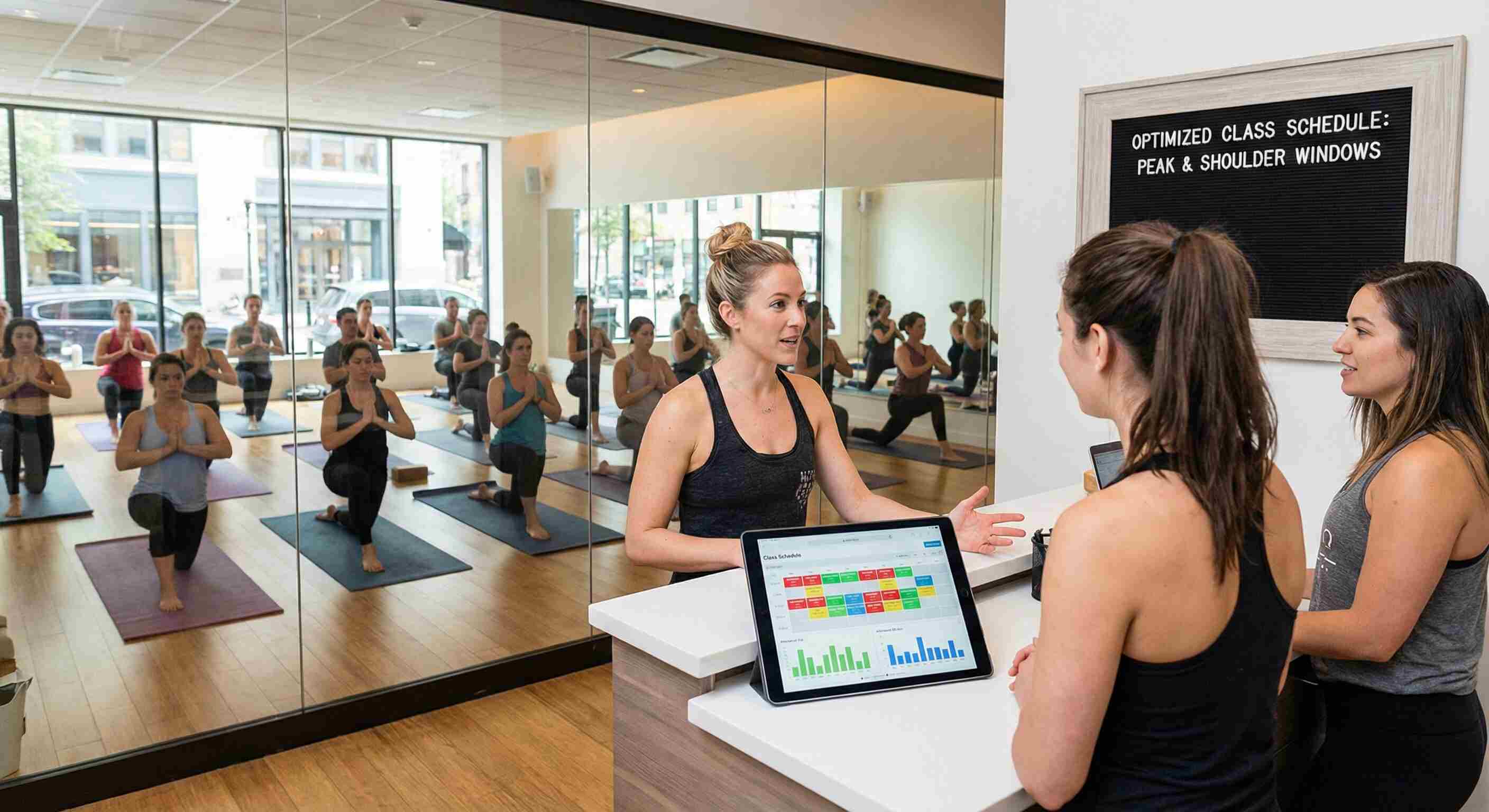
Step 1: Demand Mapping. Pull 90 days of attendance data and calculate average attendance by day of week and time slot. Identify your peak windows (typically 6-8 AM and 5-7 PM weekdays, 8-11 AM weekends), shoulder windows (adjacent to peaks), and off-peak windows (midday weekdays, late evenings). Most studios find that 60-70% of total attendance concentrates in 30-40% of their time slots.

Step 2: Breakeven Analysis per Class. Calculate the minimum attendance needed for each class to cover its direct costs. Formula: (Instructor Pay + Per-Class Operating Cost) / Revenue per Attendee. For example, if an instructor earns $75 per class, per-class overhead is $25, and average revenue per attendee is $25, the breakeven is 4 attendees. Any class consistently below breakeven for 4+ weeks is a candidate for removal or time change.

Step 3: Schedule Design. Stack your strongest class formats and top instructors in peak windows. Use shoulder windows for specialty classes (workshops, beginner series) that attract a different audience than your core peak members. Limit off-peak classes to formats with proven midday demand (restorative yoga, lunchtime express). HEURISTIC BENCHMARK: Based on operator data, studios that consolidate their schedule to 70-80% peak/shoulder classes and 20-30% off-peak classes report 20-40% higher revenue per square foot than studios with evenly distributed schedules.

Step 4: Quarterly Review. Reassess attendance data every 90 days. Remove or relocate classes that fall below breakeven for two consecutive months. Test new time slots with 8-week trial runs before committing permanently.

Exceptions include studios in markets with significant stay-at-home or remote-work populations, where midday classes may perform at peak-level attendance. Test before assuming off-peak times are low-demand.

Fitness Class Schedule Optimization vs. Static Scheduling

Fitness class schedule optimization differs from static scheduling (setting a schedule once and leaving it unchanged) in its responsiveness to data, seasonal patterns, and member behavior shifts.

Schedule Approach Comparison for Boutique Fitness Studios
Factor Optimized Schedule Static Schedule Demand-Only Schedule When to Choose
Data Usage Quarterly attendance review None after launch Real-time dynamic pricing Optimized for most studios
Revenue per Sq Ft 20–40% higher Baseline 25–50% higher (with software) Demand-only for tech-advanced studios
Instructor Scheduling Matched to demand Fixed rotation Variable (complex) Optimized for manageable staffing
Member Experience Full, energetic classes Inconsistent attendance Price fluctuations may confuse Optimized for consistent experience
Payroll Efficiency High (cut underperforming slots) Low (paying for empty rooms) High (variable pay models) Optimized for payroll control

For example, a yoga studio running 35 classes per week on a static schedule found that 12 classes averaged fewer than 4 attendees. After removing 8 underperforming classes and shifting 4 to better time slots, the studio dropped to 27 weekly classes but increased average attendance per class from 8 to 14. Revenue per square foot increased by 28%, and monthly payroll decreased by $2,400.

Conversely, dynamic demand-based pricing (charging more for peak classes, less for off-peak) can further optimize revenue but adds complexity. Studios with 100+ members and software capable of dynamic pricing (ClassPass integration, tiered credit systems) may benefit. Smaller studios should start with schedule optimization before layering on pricing complexity.

Fitness Class Schedule Optimization Examples

Fitness class schedule optimization produces different results depending on studio size, modality, and market. Here are three concrete implementations.

Example 1: Urban Cycling Studio (1,200 sq ft, 30 bikes). Before optimization: 40 classes per week, average 18 riders per class (60% utilization). After demand mapping, the studio cut midday classes from 5 to 2, added a 6:30 AM class on Tuesday/Thursday (high demand, previously unserved), and moved the Sunday 4 PM class to 9:30 AM. Result: 34 classes per week, average 24 riders per class (80% utilization), revenue per square foot increased from $22 to $31 per month.

Example 2: Suburban Pilates Studio (900 sq ft, 12 reformers). Pilates studios with reformer equipment have built-in capacity constraints. This studio ran 28 weekly classes at 75% average utilization. Optimization focused on converting the two lowest-attended evening slots into private/semi-private sessions at $65-$85 per person (versus $25-$30 for group). Result: same 28 class slots but $1,800/month additional revenue from the converted sessions. Pilates studios consistently report higher profit margins due to premium pricing and scarcity-based small-group models (Source: Financial Models Lab, 2025).

Example 3: Multi-Modality Boutique Studio (2,000 sq ft, yoga + barre + HIIT). This studio ran all three modalities across 42 weekly classes. Data showed HIIT classes averaged 85% capacity while barre averaged 45%. Optimization reduced barre from 12 to 6 weekly classes, added 4 HIIT classes in the freed slots, and introduced a barre/HIIT fusion class for the Saturday 10 AM peak. Total weekly classes dropped to 40, but average revenue per class increased by 22%.

However, cutting a class format entirely risks alienating loyal members of that modality. The multi-modality studio wisely reduced barre frequency rather than eliminating it, preserving the community while shifting resources toward higher-demand formats.

Limitations of Fitness Class Schedule Optimization

Fitness class schedule optimization improves revenue density but carries constraints that studio owners must manage.

First, schedule changes disrupt member routines. Members who built habits around specific class times will resist changes. HEURISTIC BENCHMARK: Based on operator experience, studios that change more than 20% of their schedule in a single quarter risk a 5-10% temporary attendance dip as members adjust. Communicate changes 3-4 weeks in advance and grandfather high-tenure members into transition periods.

Second, instructor relationships complicate scheduling decisions. Cutting an underperforming time slot may mean reducing hours for a valued instructor. Handle this transparently: share the attendance data, explain the business rationale, and offer first right of refusal on any new time slots that open.

Third, optimization requires clean attendance data. Studios without check-in systems (digital or manual) cannot accurately assess class utilization. Investing in a check-in process (app, tablet, or sign-in sheet) is a prerequisite for schedule optimization.

For example, a barre studio attempted schedule optimization using class registration numbers rather than actual attendance. Registration showed 15 per class; actual attendance averaged 10 (33% no-show rate). The studio made scheduling decisions on inflated data and over-staffed peak classes by two instructors. Clean data (actual check-ins) would have produced different, more profitable decisions.

What Fitness Class Schedule Optimization Is NOT
Misconception More classes equal more revenue.
Reality Every class below breakeven attendance costs you money. Fewer, fuller classes generate more revenue per square foot than a packed schedule of half-empty sessions.
Misconception You should build your schedule around instructor availability.
Reality Build your schedule around member demand, then match instructors to the demand-driven slots. Instructor availability is a constraint to manage, not the starting point for scheduling.
Fitness Class Schedule Optimization
Core Requirements
Schedule Optimization requires Demand Mapping (90-day data)
Schedule Optimization requires Breakeven Analysis per Class
Demand Window Allocation
Demand Mapping identifies Peak, Shoulder, and Off-Peak Windows
Breakeven Analysis determines Minimum Viable Attendance
Peak Windows receive Top Instructors and Proven Formats
Shoulder Windows receive Specialty and Beginner Classes
Off-Peak Windows limited to Proven Midday-Demand Formats
Outputs & Metrics
Schedule Optimization produces Higher Revenue per Square Foot
Quarterly Review validates Schedule Performance
Payroll (30% of Revenue) controlled by Instructor-to-Demand Matching
Class Utilization Rate predicts Studio Profitability
Competitive Alternatives
Schedule Optimization competes with Static Scheduling
Schedule Optimization competes with Dynamic Demand Pricing
Essential Insights
1 Fitness class schedule optimization increases revenue per square foot by 20–40% through demand-aligned class placement and breakeven-based slot management.
2 At most boutique studios, 60–70% of total attendance concentrates in just 30–40% of available time slots.
3 Schedule optimization reduces payroll waste, since approximately 30% of boutique studio revenue goes to instructor compensation.
4 Quarterly 90-day data reviews prevent schedule stagnation and adapt to seasonal demand shifts.
5 Consolidating from 35 to 27 weekly classes can increase average per-class attendance by 75% while reducing payroll costs.
6 Clean check-in data is essential — registration numbers overstate actual attendance by 20–35% due to no-show rates.
7 Changing more than 20% of slots in a single quarter risks a 5–10% temporary attendance dip among existing members.
8 Pilates studios with reformer equipment achieve premium revenue per square foot through scarcity-based small-group pricing at $65–$85 per session.

FAQ

Q1: What is fitness class schedule optimization?

A: Fitness class schedule optimization is an operational strategy that aligns class times, formats, and instructor assignments with member demand patterns to maximize revenue per square foot of studio space. The process involves demand mapping, breakeven analysis per class, data-driven schedule design, and quarterly performance reviews.

Q2: How does fitness class schedule optimization increase revenue per square foot?

A: Fitness class schedule optimization increases revenue per square foot by 20-40% through concentrating classes in peak-demand windows, cutting below-breakeven time slots, and matching top instructors to high-attendance periods. Studios that consolidate schedules report fuller classes, lower payroll waste, and higher per-class revenue without adding square footage.

Q3: How do you calculate breakeven attendance for a fitness class?

A: Breakeven attendance for a fitness class equals (Instructor Pay + Per-Class Operating Cost) divided by Revenue per Attendee. Fitness class schedule optimization uses this formula to identify classes that consistently lose money. Any class below breakeven for 4 or more consecutive weeks is a candidate for removal or time-slot relocation.

Q4: How often should a boutique studio change its class schedule?

A: Fitness class schedule optimization works best with quarterly reviews using 90 days of attendance data. Schedule changes should be limited to 20% or fewer of total time slots per quarter to avoid disrupting member habits. Studios should communicate changes 3-4 weeks in advance and test new time slots with 8-week trial runs before permanent commitment.

Q5: What are the limitations of fitness class schedule optimization?

A: Fitness class schedule optimization has three key limitations: schedule changes disrupt member routines (risking 5-10% temporary attendance dips), instructor staffing creates emotional and contractual complications, and the process requires clean check-in data that many studios lack. Registration numbers overstate actual attendance by 20-35% due to no-show rates.

Q6: Should a fitness studio add more classes to increase revenue?

A: Fitness class schedule optimization shows that adding classes below breakeven attendance reduces profitability. Studios benefit more from fewer, fuller classes than from a packed schedule of half-empty sessions. One yoga studio cut from 35 to 27 weekly classes and increased average attendance per class from 8 to 14, raising revenue per square foot by 28%.

Q7: How does fitness class schedule optimization compare to dynamic pricing?

A: Fitness class schedule optimization uses time-slot management and format placement to maximize revenue, while dynamic demand pricing adjusts per-class rates based on demand levels. Schedule optimization is accessible to all studios (no special software required) and produces 20-40% revenue-per-square-foot gains. Dynamic pricing can achieve 25-50% gains but requires pricing software and risks confusing members with fluctuating rates.

All statistics verified as of February 2026. This article is reviewed quarterly. Strategies and pricing may have changed.

fitDEGREE can support your Studio Fitness

Consult with us now!
Share
Looks like you are finding this valuable, would you also like our latest copy of Navigating the New Normal?
Thank you! Your submission has been received!
Oops! Something went wrong while submitting the form.

How to Build a 90-Day Member Retention System for Your Boutique Studio

How to Build a Class Schedule That Maximizes Revenue per Square Foot

Fitness Studio Pre-Launch Marketing: The 90-Day Framework to Open with Paying Members

Black Friday 2025: What's New and How to Make It Your Studio's Best Sale Yet

First Class Free Policy: How Fitness Studio Owners Can Protect Value While Converting Leads

Fitness Studio Growth Plateau: How to Break Through Operational Bottlenecks and Scale Beyond Year Two

Solo Fitness Studio Management: How to Run Bookings, Payments, and Operations Without Staff

Fitness Software Built by Industry Experts: How Research-Driven Development Outperforms Tech Company Solutions

Easy-to-Use Gym Management System: What Boutique Studios Actually Need

Low-Budget Marketing for Boutique Fitness Studios: Community-First Strategies That Work

Simple Fitness Studio Booking System: Why Fewer Clicks Wins

Boutique Fitness Studio Software: Built for Real Studios, Not Enterprise Gyms

Gym Class Scheduling Software: Simple Solutions for Real Studios

Predictive Analytics for Gym Retention: Do Small Studios Really Need Fortune Telling Software?

Smart Gym Management Automation: What Small Studios Actually Need in 2025

AI-Powered Fitness Studio Insights: Do Small Studios Really Need Them?

The Q4 Blueprint: How Fitness Studios Can Hit Their 2025 Goals Before the Year Ends

Mastering the Re-Engagement Campaign: Turn Inactive Fitness Clients Into Regulars

Beyond the Pretty Posts: A Real-World Guide to Digital Marketing for Fitness Studios

Boutique Fitness Studios: Why September Brings More Clients Than January

Christmas in July: Your Studio’s Mid-Year Revenue Booster

4 Summer Fitness Studio Ideas That Build Community and Boost Loyalty

Grow Your Studio without Stress: Check These 3 fitDEGREE Reports Every Monday

The fitDEGREE Reports That Predict Client Retention (and Show You Who's at Risk)

3 Data Points That Predict Studio Revenue Growth (and How to Track Them in fitDEGREE)

Building Retention in a Cancel-Anytime World: 3 Strategies Boutique Studios Can Use Now

How to Text Like a Human and Get More Fitness Studio Bookings

Spring Marketing Strategies for Fitness Studios: How to Attract More Clients as the Weather Warms Up

Top 5 Legal Agreements Every Successful Boutique Fitness Studio Needs

Maximize Your Studio's Profitability: The Studio Budgeting Blueprint to Financial Freedom

What Studio Owners Need to Know About the FTC's "Click to Cancel" Rule

Transform Your Fitness Studio with an Engaging 30-Day New Year's Challenge

Five Ways to Optimize Your Gym's Marketing Strategy for the New Year Rush

7 Steps to Prioritize Self-Care as a Studio Owner During the Holiday Season

Thriving During the Holidays: Adapting to Seasonal Trends in Fitness

Your Fitness Studio Needs a Comprehensive Black Friday Strategy – and You Should Start Early

Boost Your Fitness Studio Membership with the Power of Social Proof

Boost Your Studio's Retention with Annual Member Appreciation Week

Maximizing Your Q4: Strategies for Studio Owners to Crush 2024 Goals

Don't Do it Alone. Elevate Your Fitness Studio with These 5 Expert Growth Strategies

The Ultimate Checklist for Planning an Effective Fitness Studio Open House

Struggling to Find Leads? Boost Your Boutique Fitness Studio with Lead Magnets

Automate or Call? How to Choose When to Use Automations and When to Reach Out Personally in Your Fitness Studio

The Power of Taking Breaks: Why Your Boutique Fitness Studio Should Embrace Holiday Closures

Re-Engaging At-Risk Clients: 7 Tips to Reduce Cancellation Rates

Fitness Industry Summers: How to Make the Most of a Slow Season

Seven Steps to Run an Effective Fitness Studio Challenge to Increase Engagement and Revenue

Get More Gym Leads with Nurses and Teacher Appreciation Week

Boost Member Engagement and Retention in Your Studio with Intentional Programming

Membership Renewal Strategies: Keep Your Gym Clients Committed Year after Year

Seven Ways to Provide Exceptional Service in Your Studio to Stand Out and Keep Members

Membership Models Demystified: Finding the Right Fit for Your Fitness Studio

Building a Strong Community: How to Foster Authentic Connections in Your Boutique Fitness Studio

Customer Spotlights: Showcasing Success Stories to Boost Gym Engagement

2024 Fitness Trends: Embracing The New Boutique Fitness Trends to Stay Ahead

Elevate Your Studio: The Power of Customer Spotlights to Boost Gym Engagement

Elevate Your Boutique Fitness Studio: Year-End Reflections for Ongoing Success

Unwrap Your Gym's Irresistible Holiday Campaign in 4 Steps.

Unleashing the Power of Newsletters: A Guide for Fitness Studio Owners to Boost Holiday Engagement

How to Boost Your Boutique Fitness Studio's Social Media Presence

Social Media Marketing For Fitness Studios: Building Genuine Connections Over Vanity Metrics

Mastering Employee Management: Best Practices for Boutique Fitness Studio Owners

Crafting a Comprehensive Handbook for Your Boutique Fitness Studio

Crafting a Successful First Year: Must-Have Events for Your Boutique Fitness Studio

Are Your Boutique Fitness Studio's Monthly Costs Weighing You Down? Here's How to Find Out

Revamp Your Fitness Studio: A Guide for Successfully Deciding When to Pivot

How to Create Effective Business Goals for Your New Boutique Fitness Studio: A Comprehensive Guide

Ready, Set, Launch: Your Fitness Studio's Complete Opening Day Checklist

How to Find, Interview, and Hire Staff for Your Fitness Studio

Boosting Your Fitness Studio's SEO Effortlessly: Simple Tips for Studio Owners

The Power of Video Marketing: How Fitness Studio Owners Can Attract More Clients

Six Strategies To Create And Market Your Boutique Studio’s Value Proposition

7 strategies for your boutique gym to compete against large brands

What Type of Financing is Right For My New Fitness Business? A Complete Guide

Six Steps to Create Your Fitness Studio’s Successful Business Plan

Your Complete Checklist to Market Your Fitness Business

How to Create a Captivating Founder’s Story For Your Fitness Studio

How to Identify Your Boutique Gym’s Ideal Client

Four Steps to Create the Perfect Mission Statement for Your Fitness Studio

3 Steps to Build a Strong Brand Strategy for Your Fitness Business

How to choose the perfect space for your fitness studio

Finding a niche for your new business

How to Leverage Business Partnerships to Improve Your Fitness Business

Improve Your Gym's Sales Success With Three Simple Questions

Black Friday Marketing: Your Complete Checklist for Fitness Studios

Three Steps to Improve Your Gym's Sub Policies

Do your staff feel appreciated? How to Improve retention with Employee Appreciation Week.

Seven Questions to Keep Your Gym Staff Happy and Engaged

The free marketing tool you need in your fitness business

Your Gym Needs a Budget: How to Increase Your Fitness Business’s Profitability in Six Steps.

Stop Doing it All: 4 Partners to Help Your Fitness Business Grow

How to Overcome Common Sales Objections to Sell More Gym Memberships

Six Ways to Improve Staff Effectiveness and Retention in your Gym

Eight Steps to Sell More Fitness Memberships

The Three Essential Objectives to Improve Gym Sales and Profitability

How to increase attendance and retention in your gym this summer

How to Increase Your Boutique Studio Sales by Optimizing Your Intro Process

Are your clients staying? Improve your gym's retention rate with these strategies

8 reasons why your intro offer isn’t converting into long-term memberships

Are large class packages harming your gym's business? How to price for competitive growth.

Posts You Might Like

Software Updates

Software Update Img- Fit Degree
Want to know about the
latest improvements to fitDEGREE?
See Latest Software Updates
Black Friday
Calender Icon Img- Fit Degree
sale
Ready to switch to a more affordable, customer-friendly management tool? We've got you covered.
Schedule a Free Firdegree Demo

Get all the resources
in your inbox

Thank you! Your submission has been received!
Oops! Something went wrong while submitting the form.

About the author:

img
Nick D. Hale

Nick Hale is the CEO & Co-Founder of fitDEGREE and one of the leading voices on wellness business growth

CEO + Co-Founder
About Nick D. Hale

Nick Dennis. Nick is a co-founder of fitDEGREE and has been involved in the fitness business for quite some time now both from the gym staff and software side of things. He may be an “accidental entrepreneur” but he surely knows how to get the job done!

imgimg